01

This week

Posts, reels, an article and a game — one swipe each.

↓9 frames · swipe

This week

Two reels, a few posts, one whole article and a game. Nothing here was picked by a machine.

Tapswipe

We shipped tapswipe 1.2.

Every page is one MDX file now: a post is its words and then its picture, a reel is its video and a line, a feed is a list of the pages it shows.

No lists that fill themselves in. If it is on a page, somebody put it there.
#release

Video reel: web history

From one page on one server to a feed somebody else sorts.

Four places to publish, scored the same way: how it feels on a phone, who owns the address, who owns the audience.

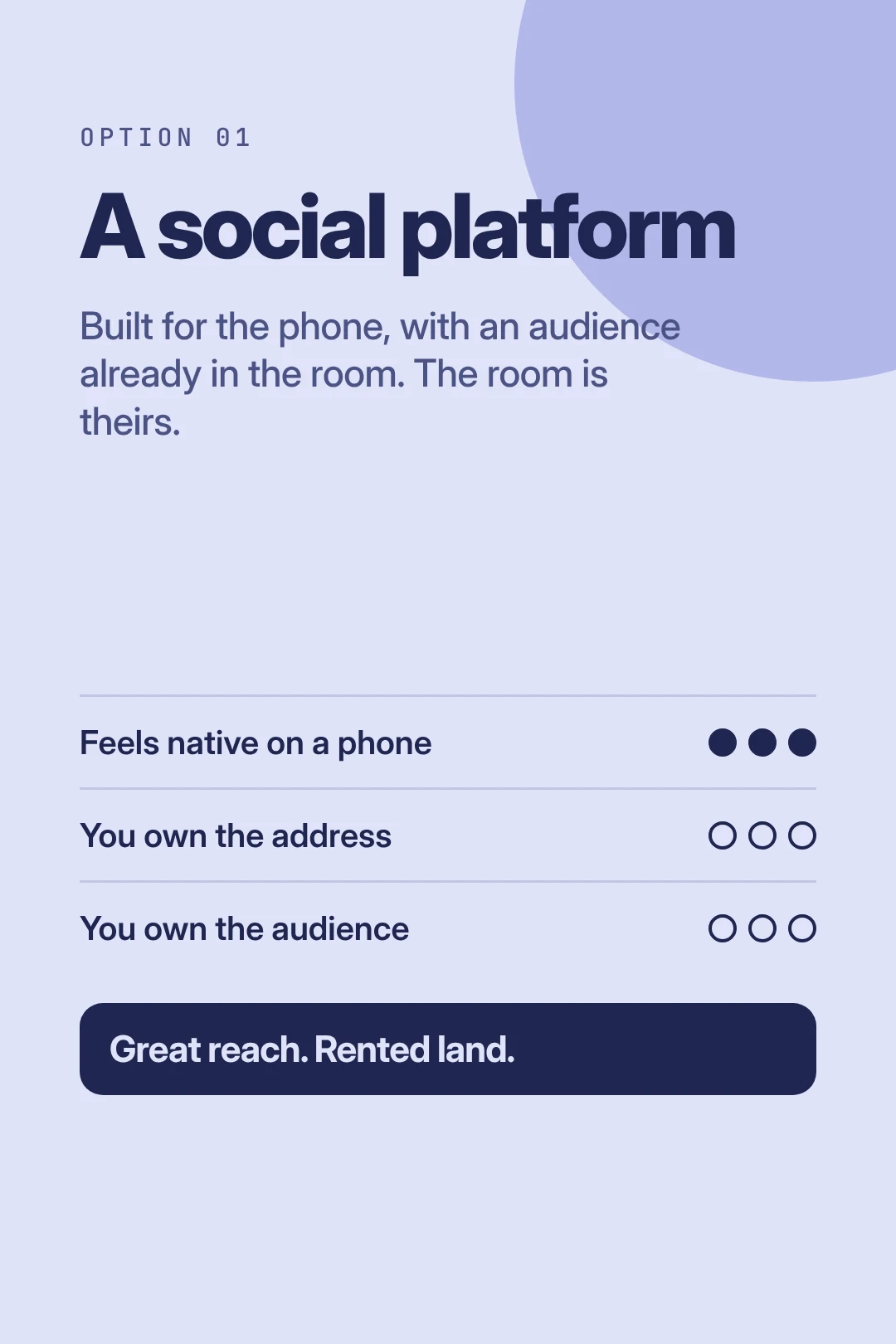
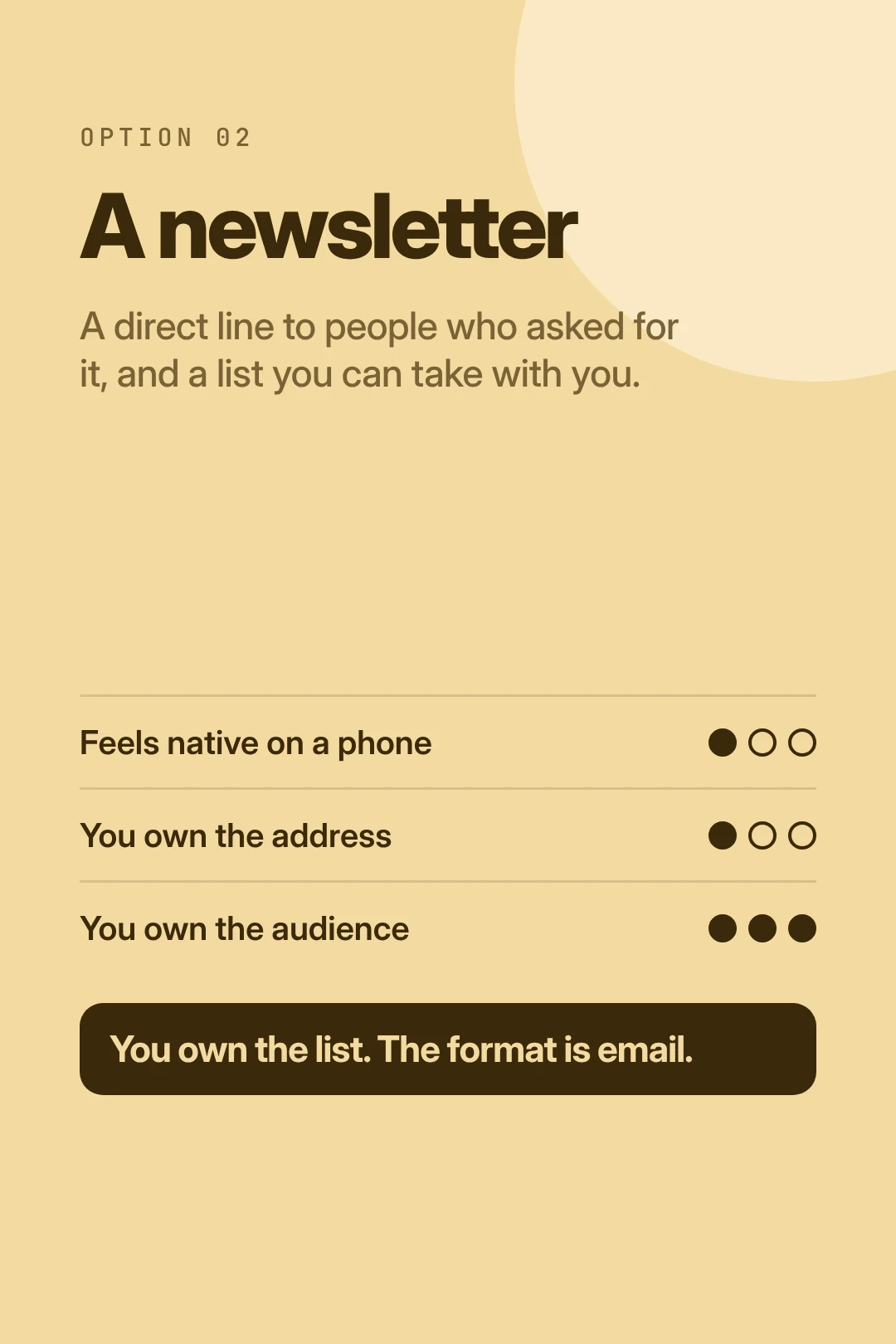
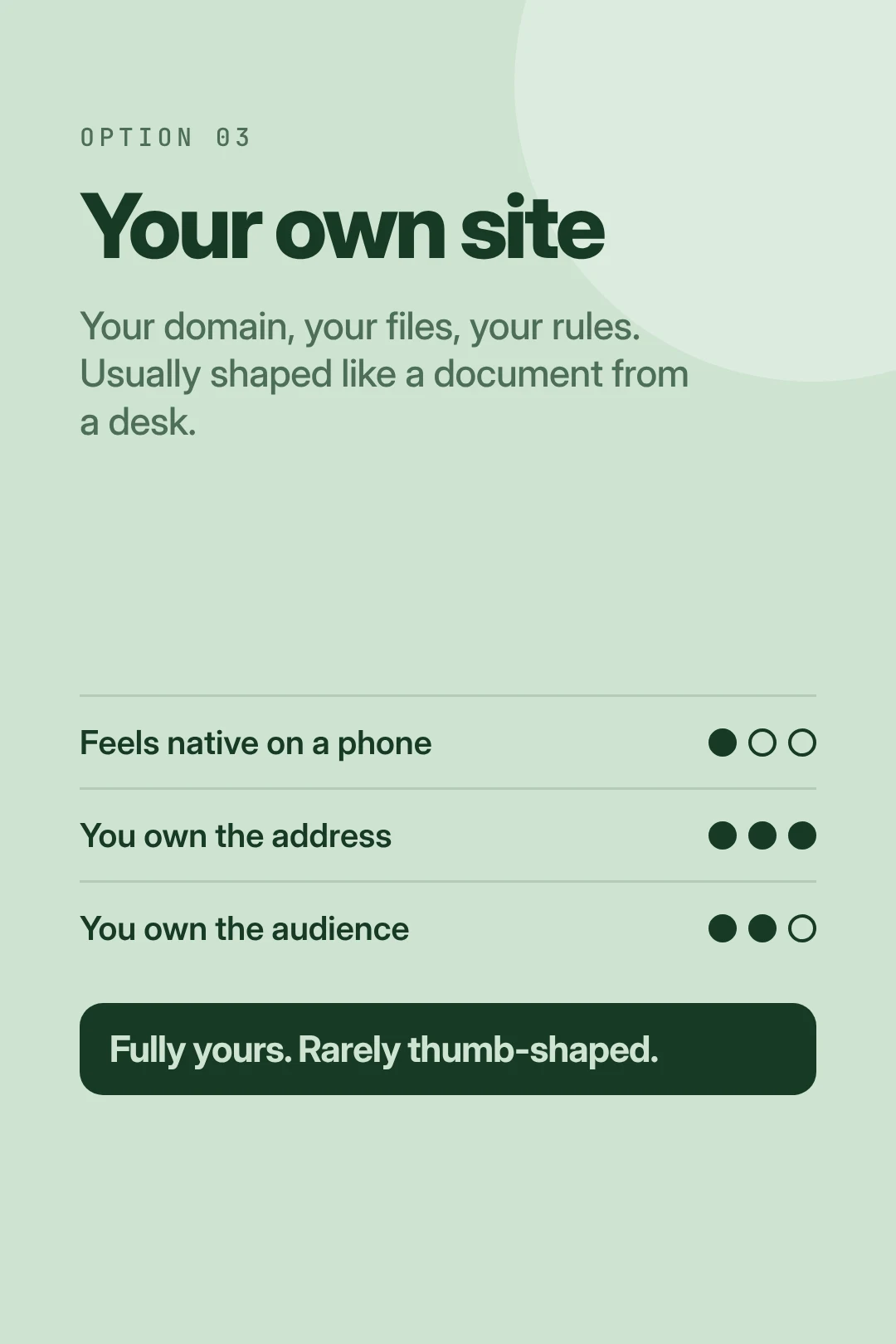
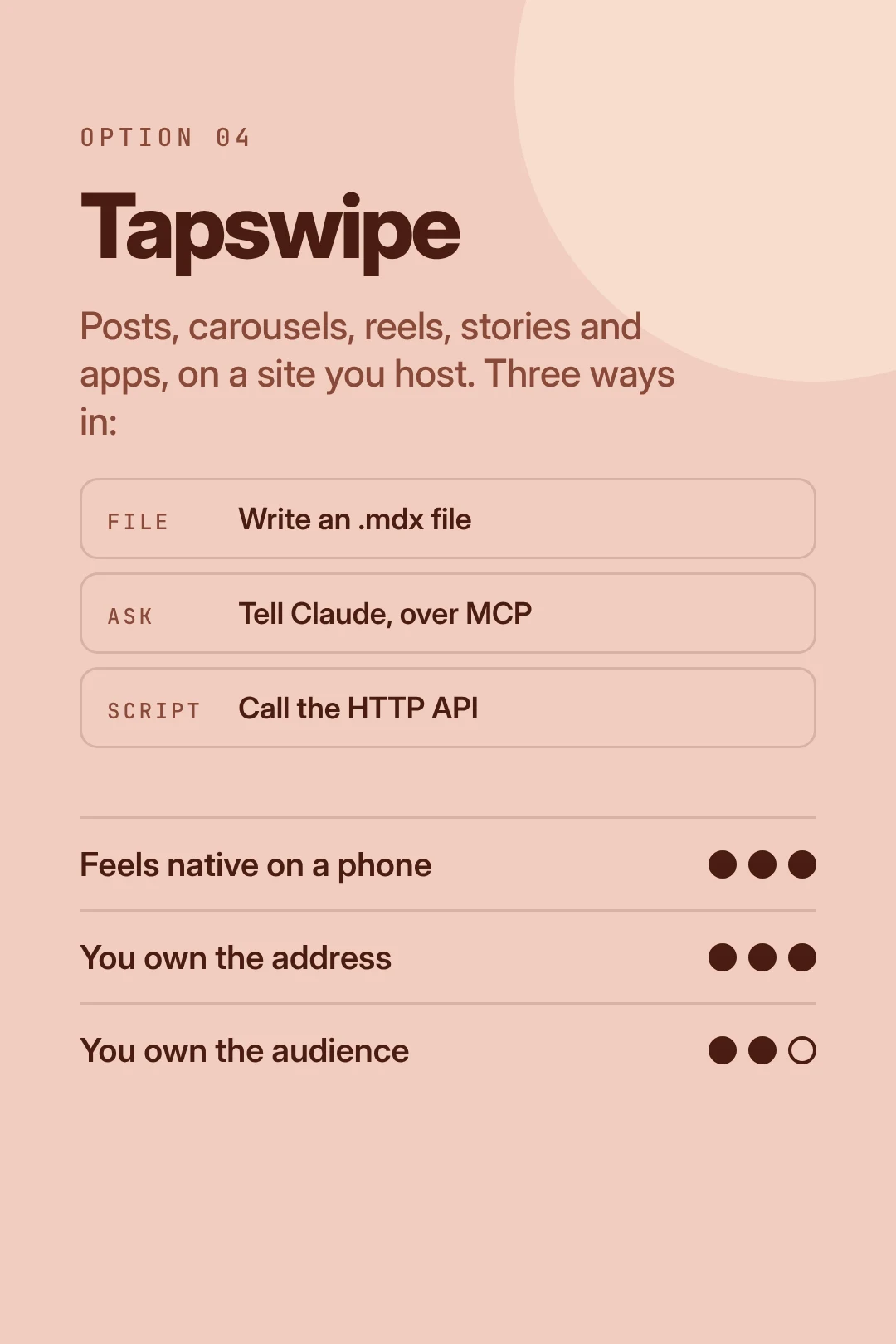
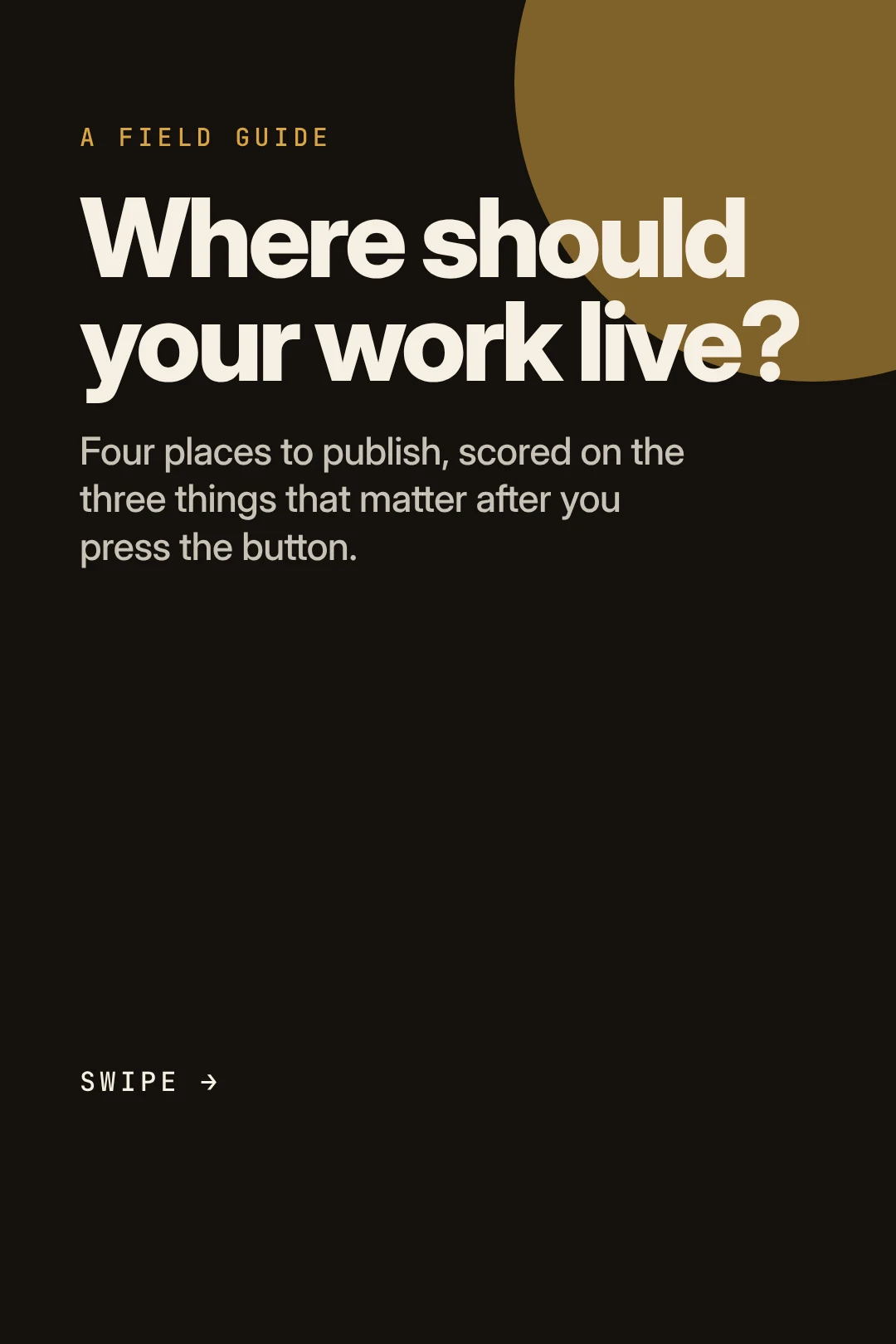
Title slide: Where should your work live? Four places to publish, scored on three things.
A social platform: feels native on a phone 3 of 3, you own the address 0 of 3, you own the audience 0 of 3. Great reach, rented land.
A newsletter: native on a phone 1 of 3, own the address 1 of 3, own the audience 3 of 3. You own the list; the format is email.
Your own site: native on a phone 1 of 3, own the address 3 of 3, own the audience 2 of 3. Fully yours, rarely thumb-shaped.
Tapswipe: write an .mdx file, tell Claude over MCP, or call the HTTP API. Native on a phone 3 of 3, own the address 3 of 3, own the audience 2 of 3.
#publishing
Soft green field with a pale horizon

note

In between

A reel written in the feed itself, between the pages it lists.

Video reel: micropayments

HTTP kept a status code for paying a cent a page. Thirty years on, it is still reserved.

Page

Colophon

What this is made of, and the decisions underneath it.

A page that scrolls, in a collection of pages that don't. Some things are a document, and pretending otherwise is a format looking for a reason.

Everything on this site is a file in content/. A file says what it is in its own frontmatter and then simply says it; nothing about a page is written twice, and nothing about it is written in a route.

Made with

  • Next.js on the App Router, statically generated — every screen is HTML before anyone asks for it.

  • Tailwind CSS for everything that is a decision about spacing or type, and a short stylesheet for the handful of things that are a contract with the paginator.

  • pretext to measure prose without touching DOM layout, which is what lets a story break across pages the way pages break in print.

  • The View Transitions API, so a tile grows into the page it opens instead of two screens cross-fading.

The three kinds

KindReads as
feedA vertical reel of full-screen frames, flicked
storyProse measured and paginated, tapped a page at a time
pageA document, scrolled — this one

A file declares its kind and gets that screen. The markdown itself goes through one renderer whichever kind it is, so a heading is a heading and a list is a list in all three.

The interesting part is never the finished screen. It is the twenty decisions that made the screen inevitable.

Type and colour

Set in Geist with Playfair Display for display sizes, and Geist Mono for the small tracked lines. Each page carries its own four colours — two for the gradient it wears, two for the text on top of it — declared alongside everything else it says about itself:

palette:
    from: '#bfdcd8'
    to: '#a1cac4'
    ink: '#1c4340'
    muted: '#3a625d'

The artwork is generated locally, so nothing on the page is fetched from anywhere else.

See also the Changelog, or go back and read Field Notes.

20

Lamplighter

A story in five streets. Tap to leap from lamp to lamp.

07

Field Notes

Observations from places, people, and everyday systems.